

The Apache "Tracker"
Extraordinary Tracking Skills

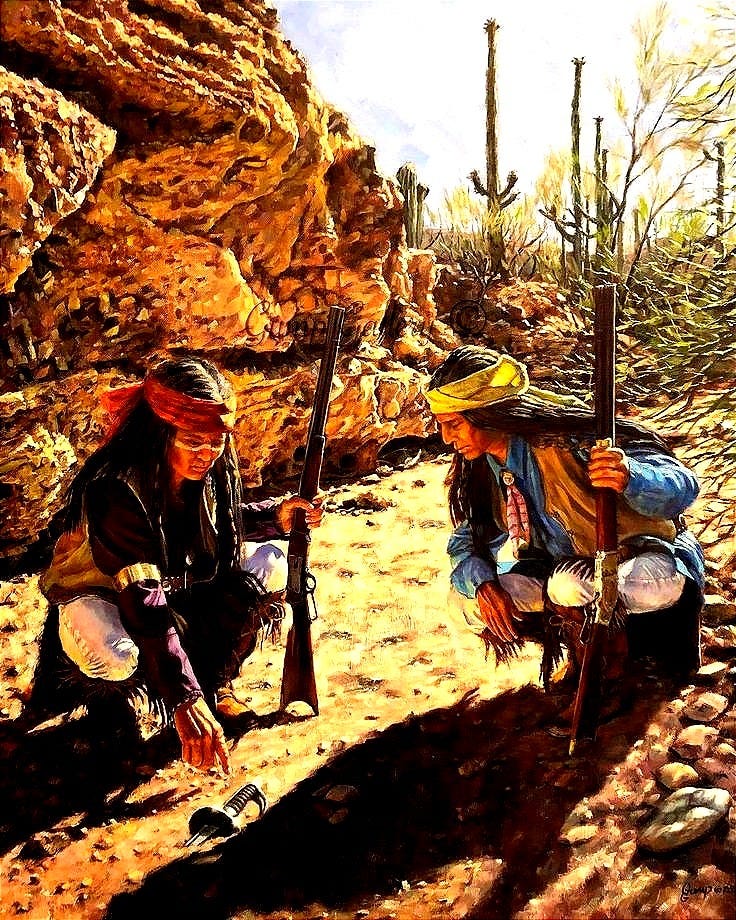
The Apaches were renowned for their extraordinary tracking skills, honed over generations of living in harmony with the rugged landscapes of the American Southwest. Here’s a fact based, fictional short story that showcases their expertise:
The Silent Shadow
Long ago, in the heart of the desert Southwest where the wind whispered secrets to the rocks, an Apache warrior named "gouʼá" (go wah) which means Thunder, was known for his unparalleled tracking skills. One evening, as the sun painted the horizon with fiery hues, Go wah’s chief summoned him to the campfire.
"A band of Mexican raiders has taken our horses and left toward the mountains," the old chief said. "Without our horses, you know we cannot hunt or protect our people. Find them, but tread carefully. They are many."
Go wah nodded, his face stern but calm. He gathered his bow, knife, firearm, and a small pouch of dried meat, then slipped silently into the darkness, guided only by the light of the moon and stars.
Reading the Earth
The next morning, as dawn broke over the jagged cliffs, Go wah began reading sign and found the first clue: a patch of disturbed earth. Kneeling beside it, he studied the hoofprints. The depth of the impressions told him the Mexican raiders' horses were burdened—likely with stolen goods. The spacing of the tracks suggested haste, but not panic. The human footprints indicated the size of the party and which direction they took. Go wah followed the trail, noting every bent blade of grass and every broken twig.
As he moved through the wilderness, He relied on more than just his eyes. He used what the Shaman’s called splatter vision and situational awareness. He listened to the songs of birds, which would change if intruders passed nearby. He felt the ground with his palms, detecting vibrations that revealed distant movement. He even sniffed the air, discerning the faint scent of campfire smoke carried by the wind.
The Clever Trap
By midday, Go wah found evidence of a hastily abandoned campsite: ashes still warm, scattered embers glowing faintly. He examined the site carefully, noting footprints leading toward a narrow canyon. The Mexican raiders were clever, he realized—they intended to ambush anyone who followed them through the bottleneck.
Go wah smiled to himself. He was wiser then that.
Doubling back, he climbed the rocky cliffs overlooking the canyon, moving as silently as a shadow. From his vantage point, he spotted the raiders hidden among the rocks, weapons ready. Counting their numbers, he realized he couldn’t confront them alone. Instead, he marked their position with a small pile of stones, then returned to his village under the cover of night.
The Final Strike
The next morning, Go wah led a group of warriors back to the canyon. Thanks to his spiritual connection with the land and his careful markings, they avoided the ambush and surprised the raiders from above. Using tried and true “guerilla tactics” the fight was brief but decisive. The raiders, caught off guard, were taken out, and the stolen horses were recovered.
As the warriors rode home victorious, the woman warrior Lozen placed a hand on Go wah’s shoulder. "Your eyes see what others miss, and your mind turns danger into opportunity. You are more than a tracker—you are the spirit of the land itself."
From that day on, Go wah’s name became well known, whispered in fear by his foes. His story was told around countless fires, a testament to the skill, patience, and wisdom of the Apache people.
Footnote; The Apaches' ability to track was a blend of observation, intuition, a deep connection with nature and their God “Usen.” They read the land as easily as others read a map, turning even the smallest clues into a complete picture of their enemies' movements.
Visit My Website APACHE TRACKER on Survival, Tracking, & Fighting Skills
